FIFTH GRADE · WORLD SHOWCASE

Ella’s Project Headquarters

El Salvador · Due Thursday, September 10

Project Overview and Grading Rubric

Learn. Choose. Create. Share.

Essential Question

How can we learn about a country by learning how people are making the world a better place?

Your Mission

You will become an expert on one country. You will research what makes your country special, investigate a challenge connected to one of the United Nations Global Goals, and develop ideas for making a difference.

You will share your learning through a creative tri-fold display and a seven-sentence speech.

The World Showcase - PDF of Canvas Explanation.pdf · page 1

The World Showcase - PDF of Canvas Explanation.pdf · page 2

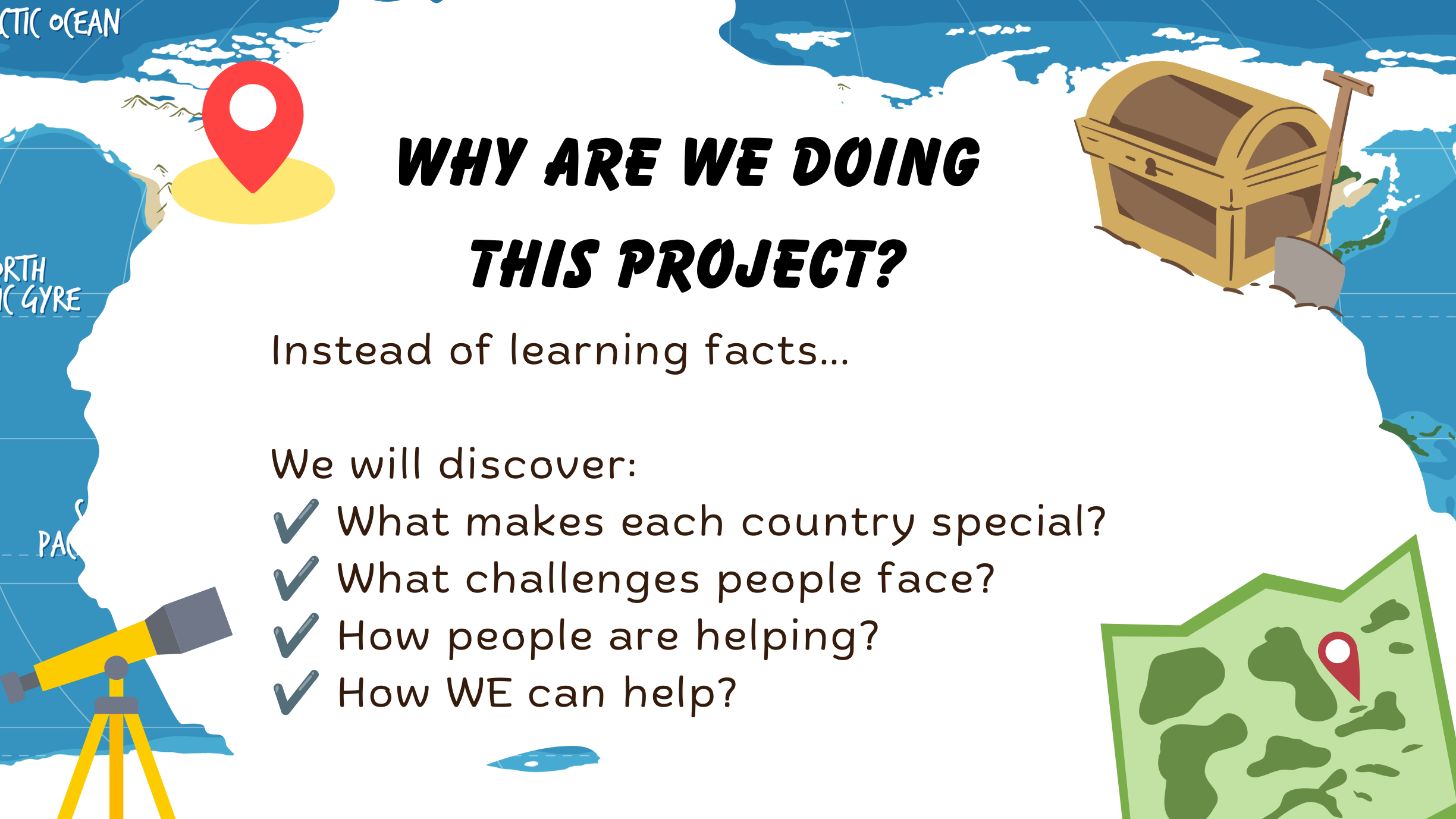
WHY ARE WE DOING THIS PROJECT?

Instead of learning facts...

We will discover:

  • What makes each country special?
  • What challenges people face?
  • How people are helping?
  • How WE can help?

From the teacher’s project introduction slide.

See my three-day plan

How my project is graded

10 = complete & strong · 9 = mostly complete · 8 = partly complete · 7 = missing. Total: 100 points.

CategoryWhat I Am Looking For
1. Country BasicsMap/location, flag, capital, and population are included and accurate.
2. Culture & FactsLanguages, food, traditions/culture, and interesting facts are included.
3. Global GoalThe chosen United Nations Global Goal is named, shown, and clearly explained.
4. Country ChallengeExplains what is happening, why it is happening, who is affected, and why it matters.
5. Helpers & SolutionsNames people/organizations helping and explains what they are doing.
6. Student ActionExplains how kids can help and includes the student's Big Idea and a strong call to action.
7. Trifold OrganizationLarge title/country name and big picture; information is placed on the correct panels and easy to follow.
8. Advocate ParagraphTyped 7-sentence paragraph includes all seven required parts and is turned in.
9. Oral PresentationSpeech is memorized/prepared, clear, complete, and presented confidently.
10. Creativity & Wow FactorTrifold is neat, colorful, visually appealing, original, and shows strong effort.
Open the teacher’s original grading rubric
Complete teacher grading rubric — all 10 criteria

THE WORLD SHOWCASE - GRADING RUBRIC

Student: ____________________________________ Country: ______________________________ Date: ______________

Quick scoring: 10 = Complete & strong | 9 = Mostly complete | 8 = Partly complete | 7 = Missing

What I Am Looking For
1. Country BasicsMap/location, flag, capital, and population are included and accurate.
2. Culture & FactsLanguages, food, traditions/culture, and interesting facts are included.
3. Global GoalThe chosen United Nations Global Goal is named, shown, and clearly explained.
4. Country ChallengeExplains what is happening, why it is happening, who is affected, and why it matters.
5. Helpers & SolutionsNames people/organizations helping and explains what they are doing.
6. Student ActionExplains how kids can help and includes the student's Big Idea and a strong call to action.
7. Trifold OrganizationLarge title/country name and big picture; information is placed on the correct panels and easy to follow.
8. Advocate ParagraphTyped 7-sentence paragraph includes all seven required parts and is turned in.
9. Oral PresentationSpeech is memorized/prepared, clear, complete, and presented confidently.
10. Creativity & Wow FactorTrifold is neat, colorful, visually appealing, original, and shows strong effort.

For each category: ☐ 10 ☐ 9 ☐ 8 ☐ 7

TOTAL: ______ / 100

GRADE: ____________

Late/other deduction: - ______

Teacher Feedback: ____________________________________________________________________________________________________________

World Showcase - Grading Rubric · complete document

The teacher’s introduction — all 13 slides

Open one slide at a time. Letter spacing and line wraps are repaired for reading; original images stay available below each slide.

Slide 1 of 13 · The World Showcase

Every country has strengths.

Every country has challenges.

Every person can make a difference.

World Showcase Project Explanation - Side Show.pdf · page 1

Open original image at full sizeOriginal slide page 1; readable text is provided above
Original source image · page 1
Slide 2 of 13 · Essential Question

How can we learn about a country by learning how people are making the world a better place?

World Showcase Project Explanation - Side Show.pdf · page 2

Open original image at full sizeOriginal slide page 2; readable text is provided above
Original source image · page 2
Slide 3 of 13 · Why are we doing this project?

Instead of learning facts...

We will discover:

  • What makes each country special?
  • What challenges people face?
  • How people are helping?
  • How WE can help?

World Showcase Project Explanation - Side Show.pdf · page 3

Open original image at full sizeOriginal slide page 3; readable text is provided above
Original source image · page 3
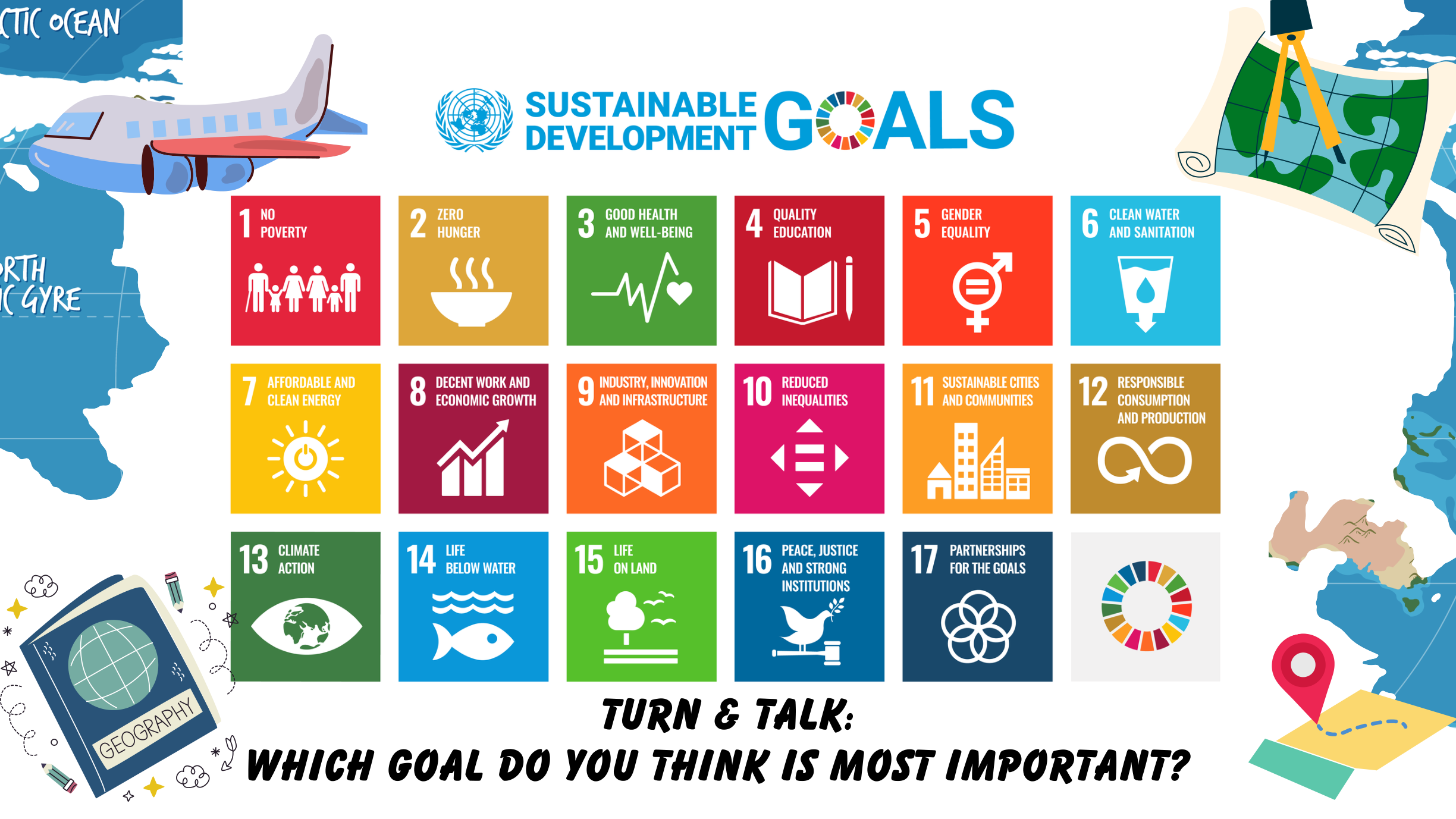
Slide 4 of 13 · Turn & Talk

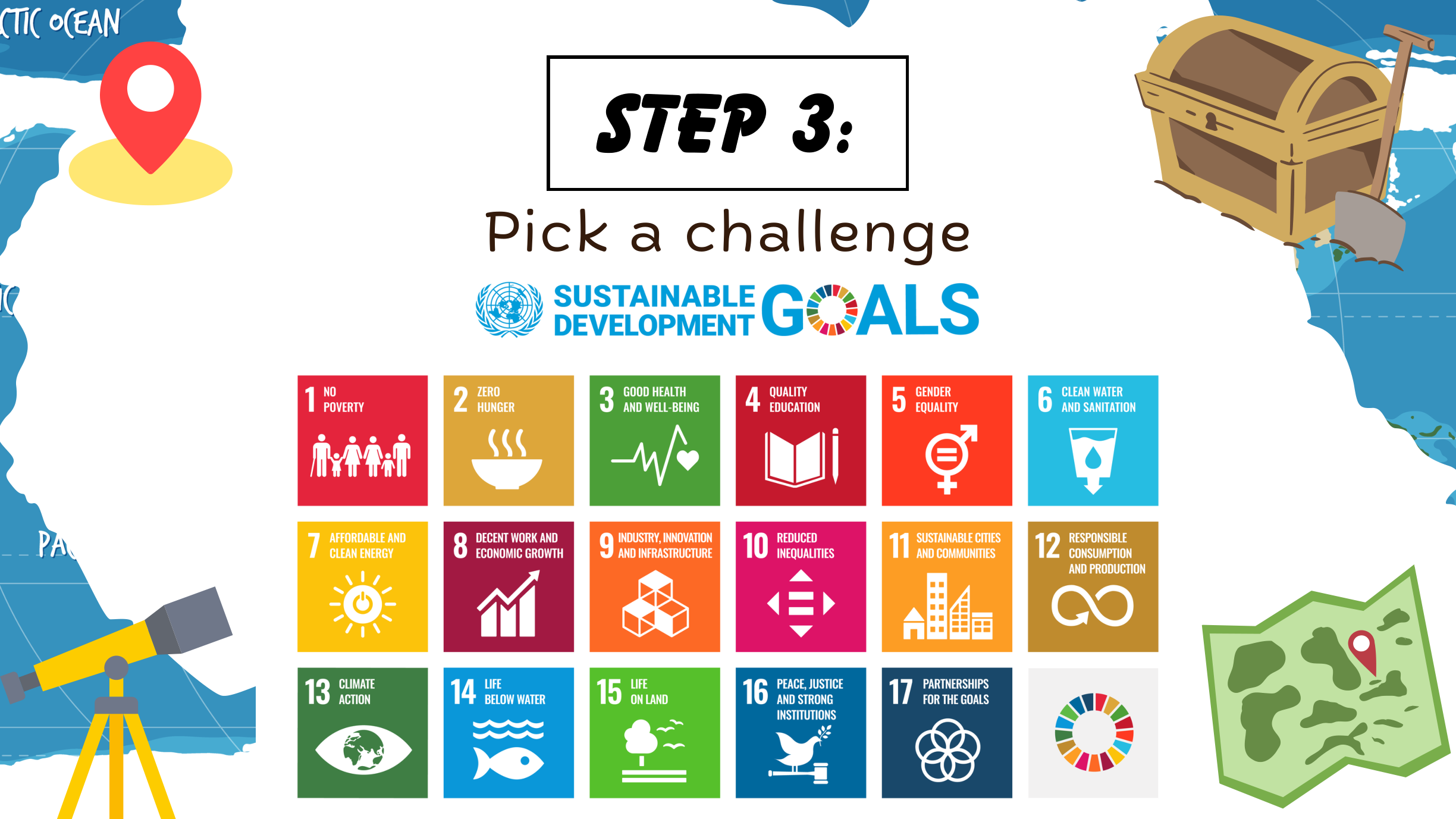
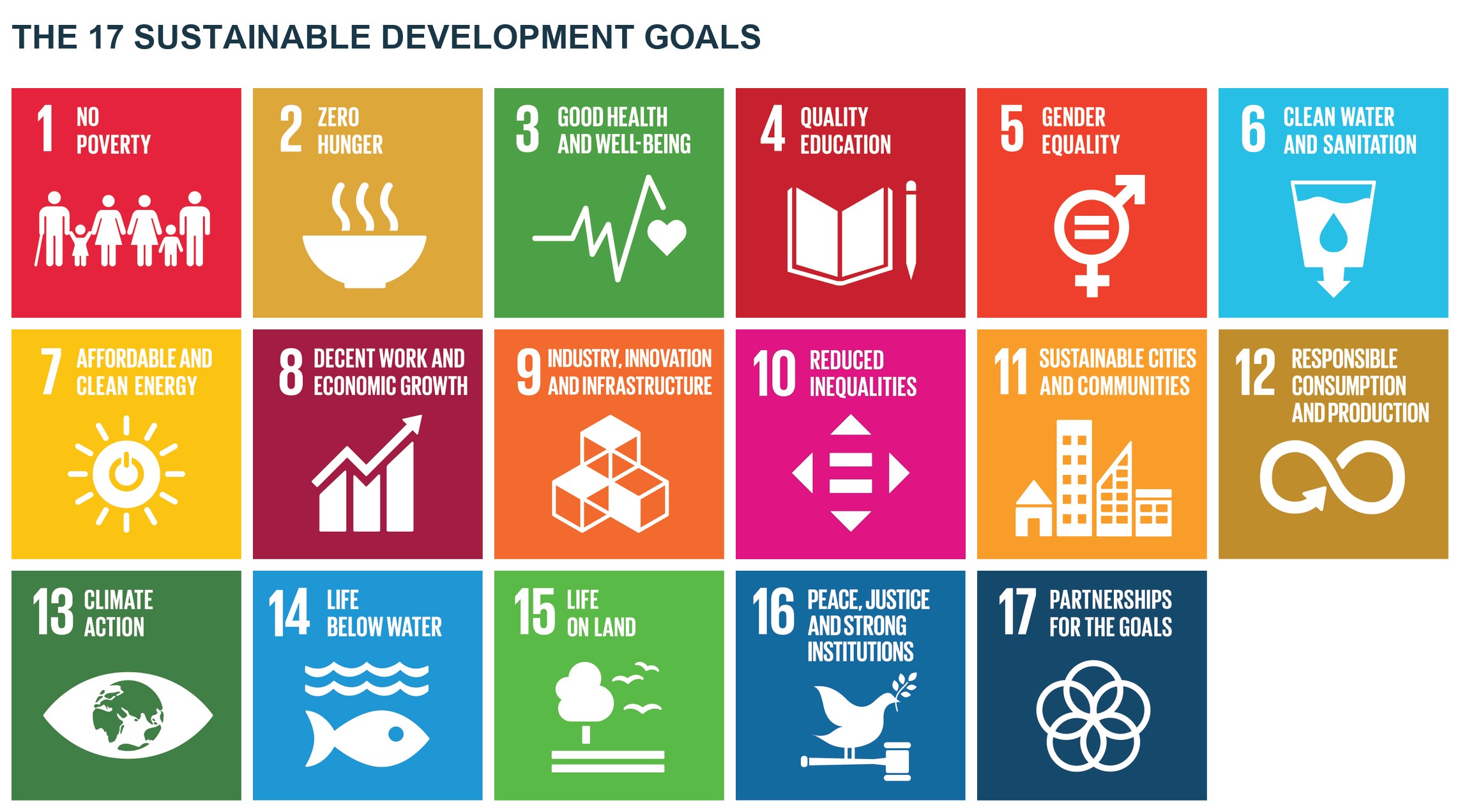
Sustainable Development Goals

  1. No Poverty
  2. Zero Hunger
  3. Good Health and Well-Being
  4. Quality Education
  5. Gender Equality
  6. Clean Water and Sanitation
  7. Affordable and Clean Energy
  8. Decent Work and Economic Growth
  9. Industry, Innovation and Infrastructure
  10. Reduced Inequalities
  11. Sustainable Cities and Communities
  12. Responsible Consumption and Production
  13. Climate Action
  14. Life Below Water
  15. Life on Land
  16. Peace, Justice and Strong Institutions
  17. Partnerships for the Goals

Which goal do you think is most important?

World Showcase Project Explanation - Side Show.pdf · page 4

Open original image at full sizeOriginal slide page 4; readable text is provided above
Original source image · page 4
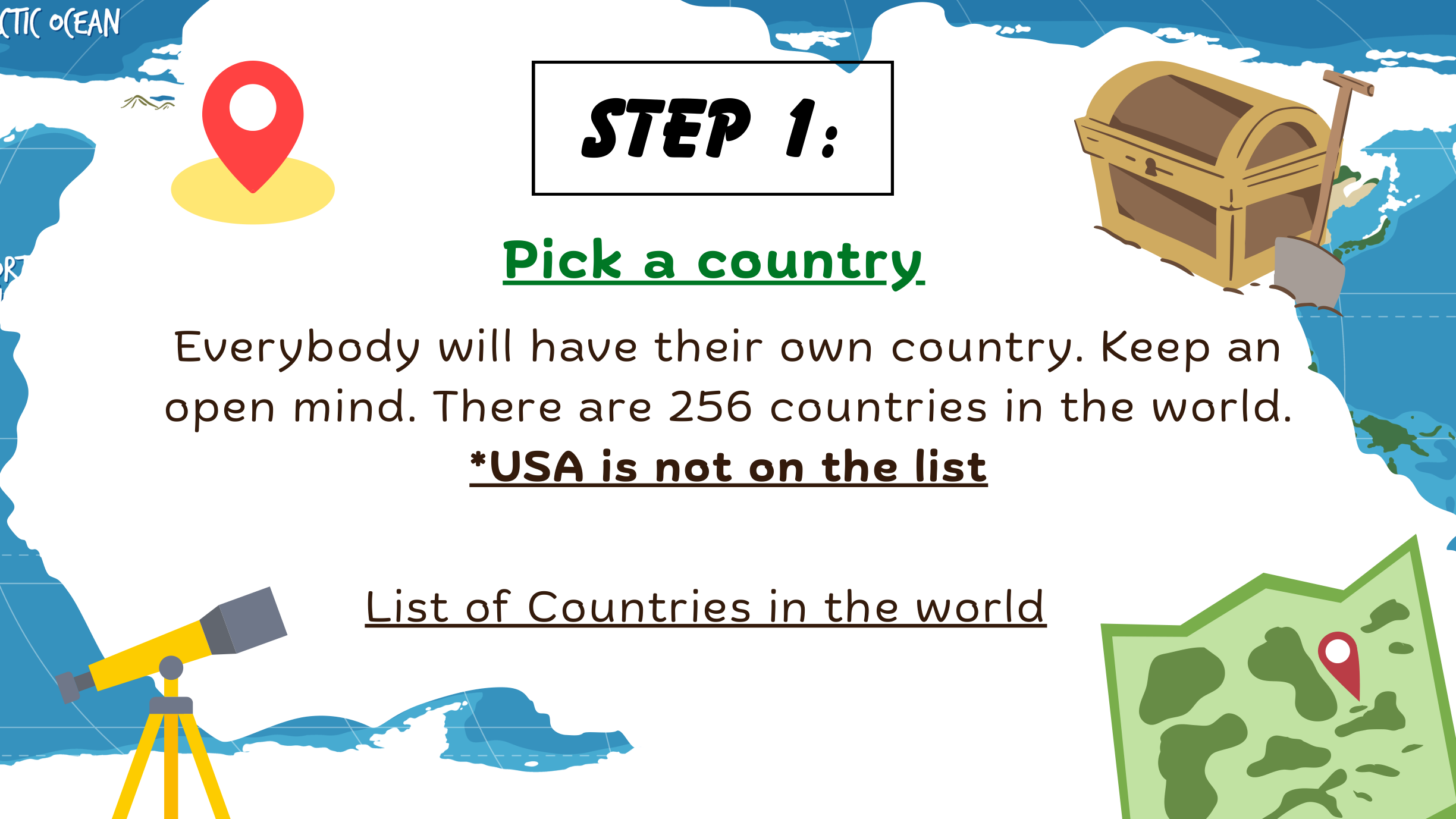
Slide 5 of 13 · Step 1: Pick a country

Everybody will have their own country. Keep an open mind. There are 256 countries in the world.

*USA is not on the list

List of Countries in the world

World Showcase Project Explanation - Side Show.pdf · page 5

Open original image at full sizeOriginal slide page 5; readable text is provided above
Original source image · page 5
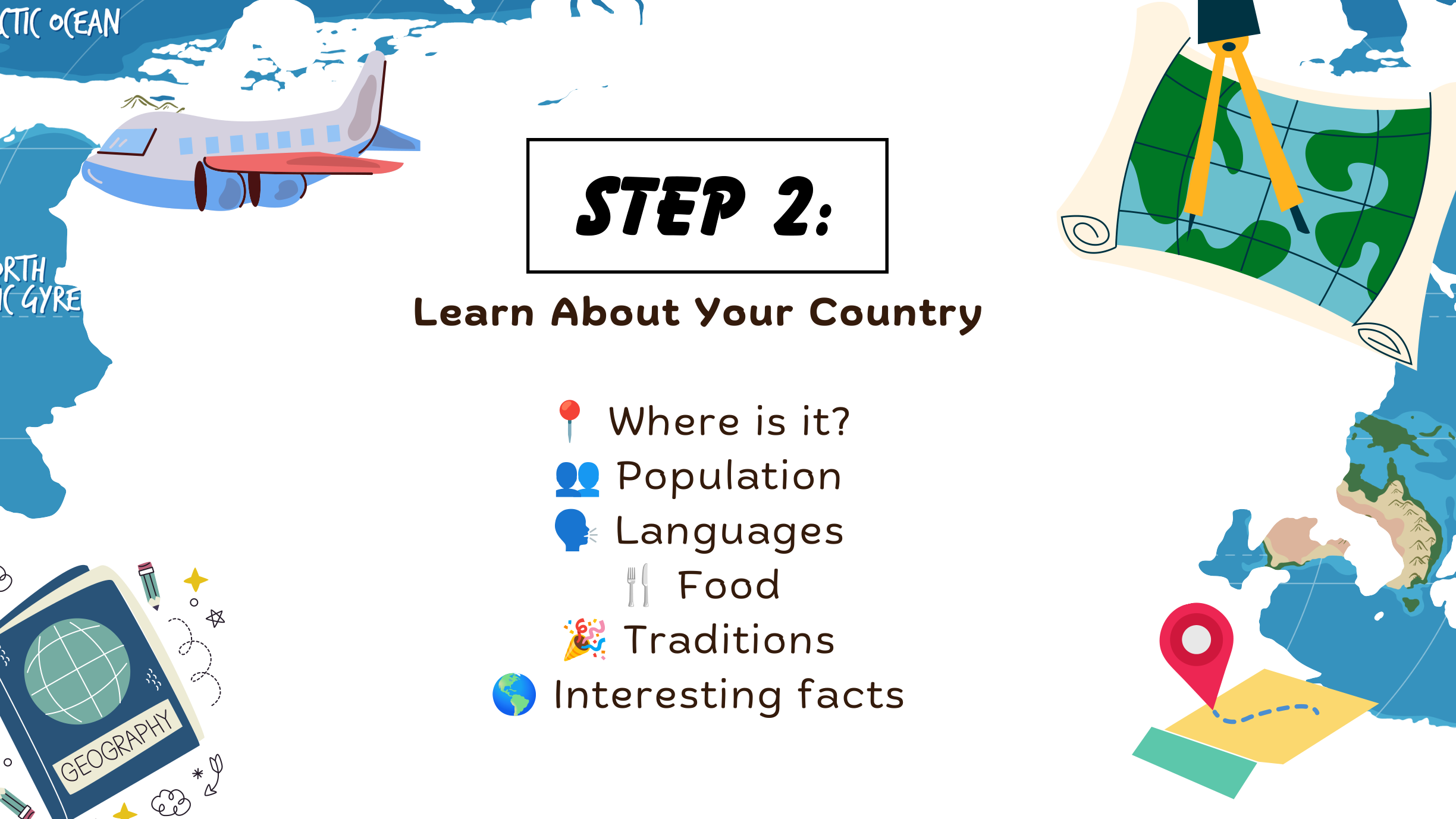
Slide 6 of 13 · Step 2: Learn About Your Country
  • Where is it?
  • Population
  • Languages
  • Food
  • Traditions
  • Interesting facts

World Showcase Project Explanation - Side Show.pdf · page 6

Open original image at full sizeOriginal slide page 6; readable text is provided above
Original source image · page 6
Slide 7 of 13 · Step 3: Pick a challenge

Sustainable Development Goals

  1. No Poverty
  2. Zero Hunger
  3. Good Health and Well-Being
  4. Quality Education
  5. Gender Equality
  6. Clean Water and Sanitation
  7. Affordable and Clean Energy
  8. Decent Work and Economic Growth
  9. Industry, Innovation and Infrastructure
  10. Reduced Inequalities
  11. Sustainable Cities and Communities
  12. Responsible Consumption and Production
  13. Climate Action
  14. Life Below Water
  15. Life on Land
  16. Peace, Justice and Strong Institutions
  17. Partnerships for the Goals

World Showcase Project Explanation - Side Show.pdf · page 7

Open original image at full sizeOriginal slide page 7; readable text is provided above
Original source image · page 7
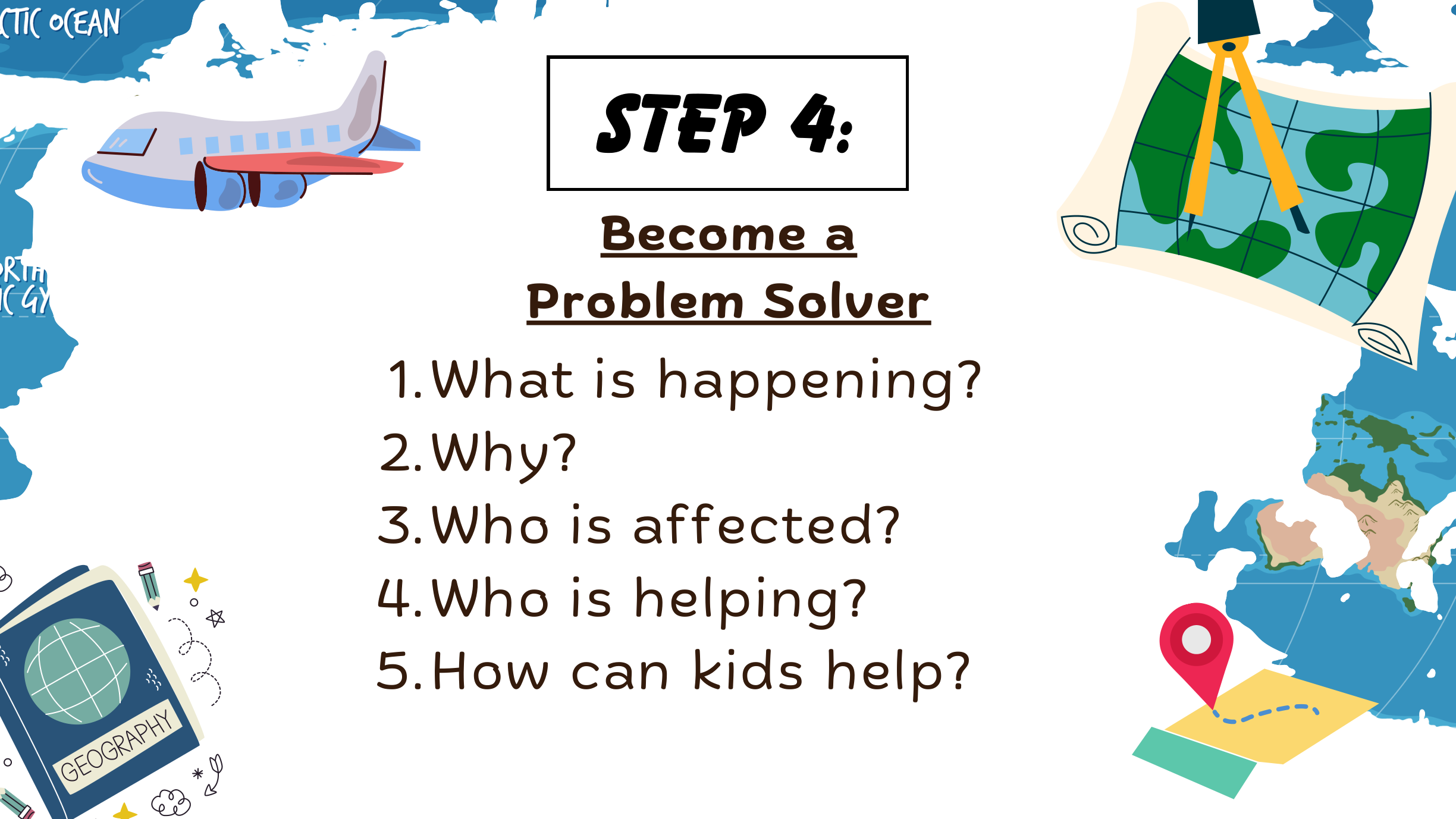
Slide 8 of 13 · Step 4: Become a Problem Solver
  1. What is happening?
  2. Why?
  3. Who is affected?
  4. Who is helping?
  5. How can kids help?

World Showcase Project Explanation - Side Show.pdf · page 8

Open original image at full sizeOriginal slide page 8; readable text is provided above
Original source image · page 8
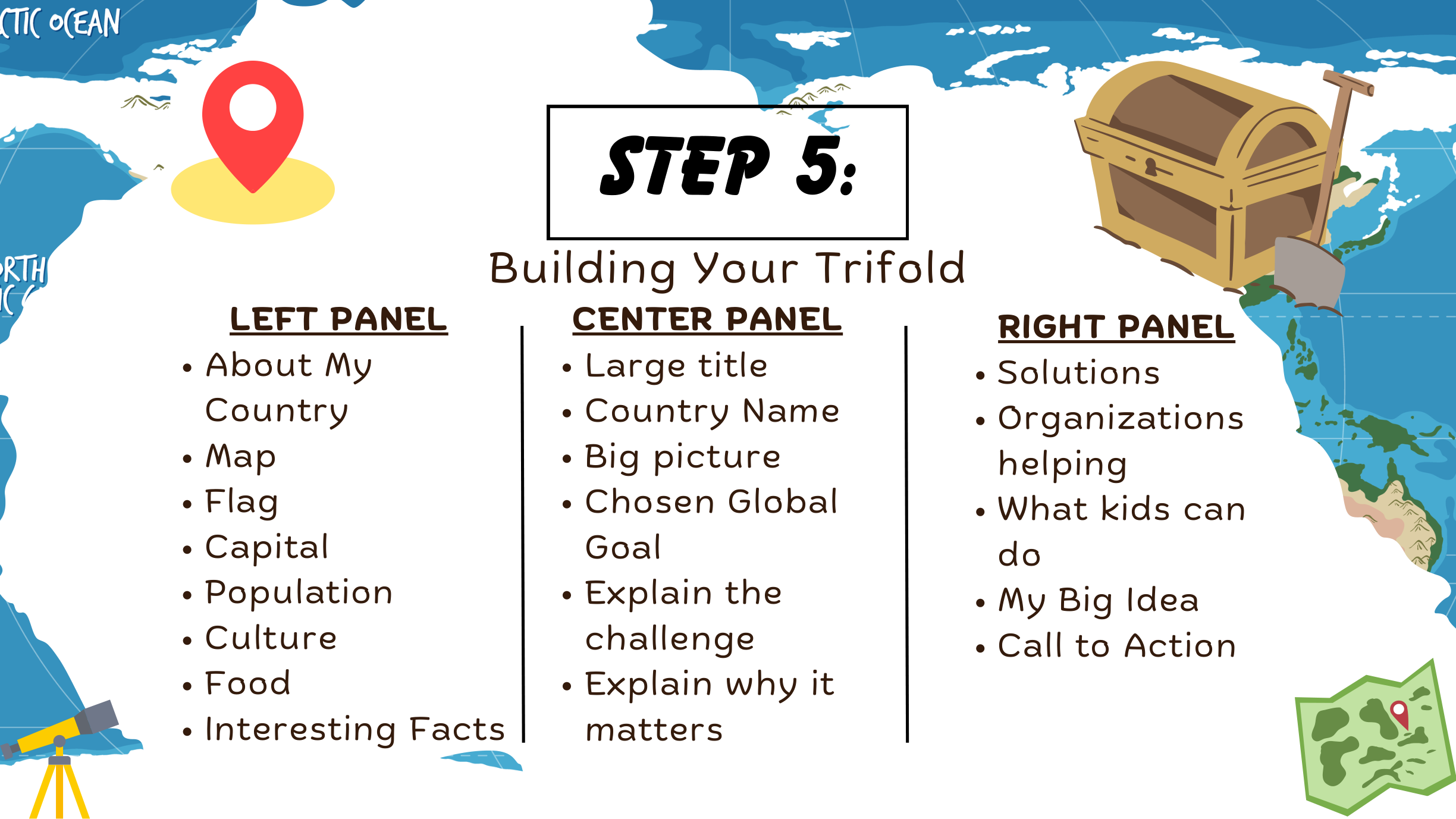
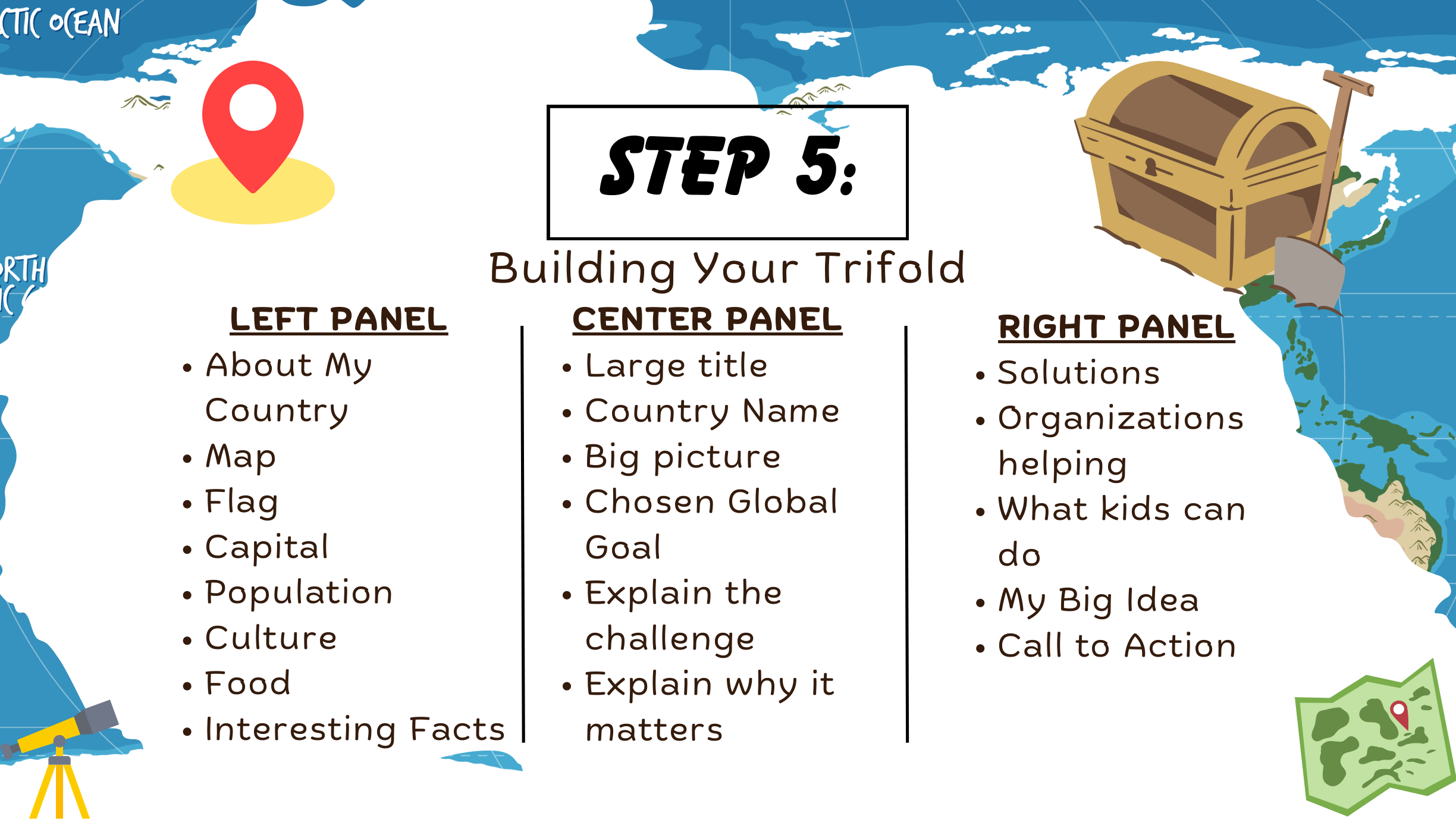
Slide 9 of 13 · Step 5: Building Your Trifold

LEFT PANEL

  • About My Country
  • Map
  • Flag
  • Capital
  • Population
  • Culture
  • Food
  • Interesting Facts

CENTER PANEL

  • Large title
  • Country Name
  • Big picture
  • Chosen Global Goal
  • Explain the challenge
  • Explain why it matters

RIGHT PANEL

  • Solutions
  • Organizations helping
  • What kids can do
  • My Big Idea
  • Call to Action

World Showcase Project Explanation - Side Show.pdf · page 9

Open original image at full sizeOriginal slide page 9; readable text is provided above
Original source image · page 9
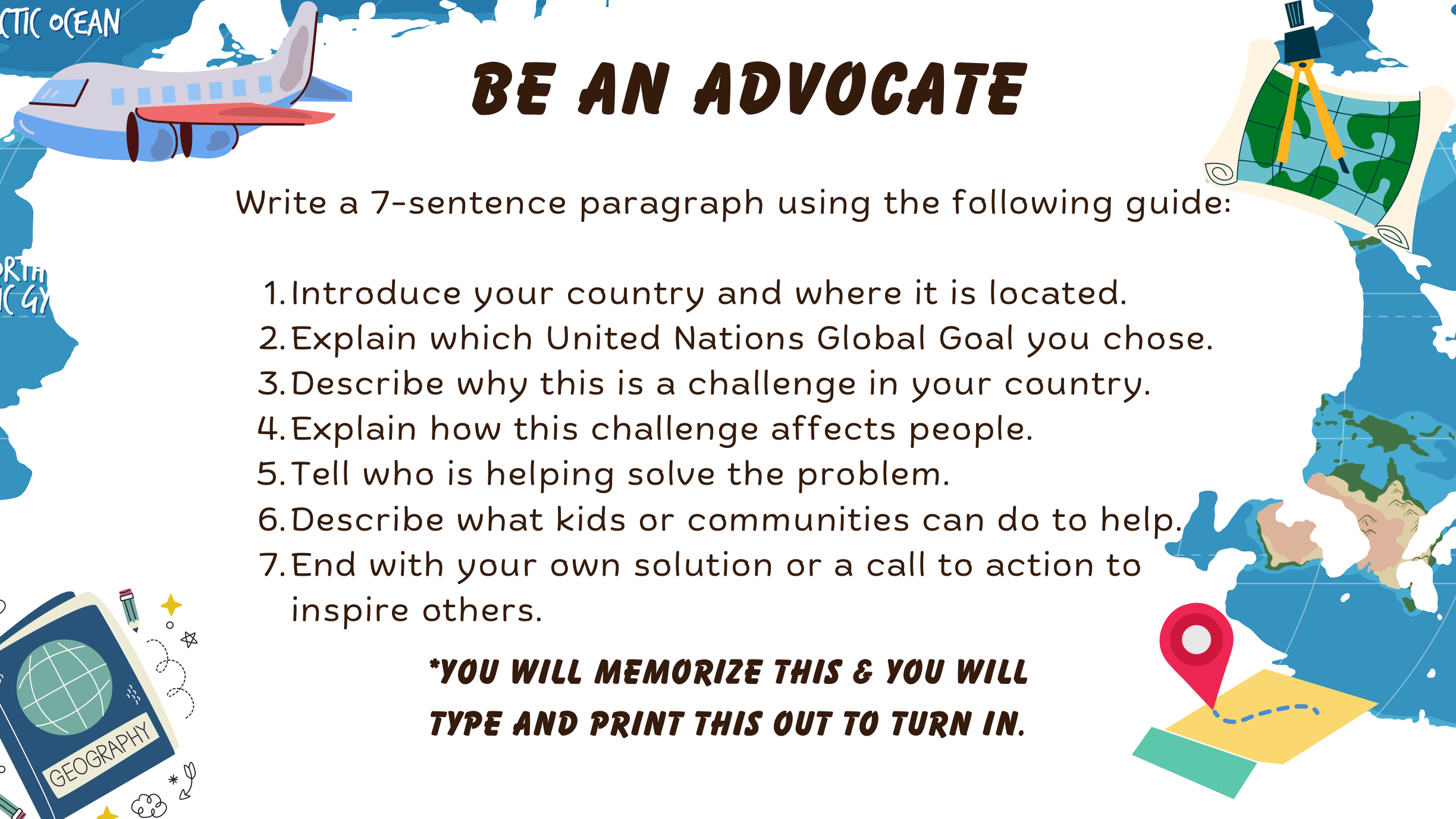
Slide 10 of 13 · Be an Advocate

Write a 7-sentence paragraph using the following guide:

  1. Introduce your country and where it is located.
  2. Explain which United Nations Global Goal you chose.
  3. Describe why this is a challenge in your country.
  4. Explain how this challenge affects people.
  5. Tell who is helping solve the problem.
  6. Describe what kids or communities can do to help.
  7. End with your own solution or a call to action to inspire others.

*You will memorize this & You will type and print this out to turn in.

World Showcase Project Explanation - Side Show.pdf · page 10

Open original image at full sizeOriginal slide page 10; readable text is provided above
Original source image · page 10
Slide 11 of 13 · Speech Example

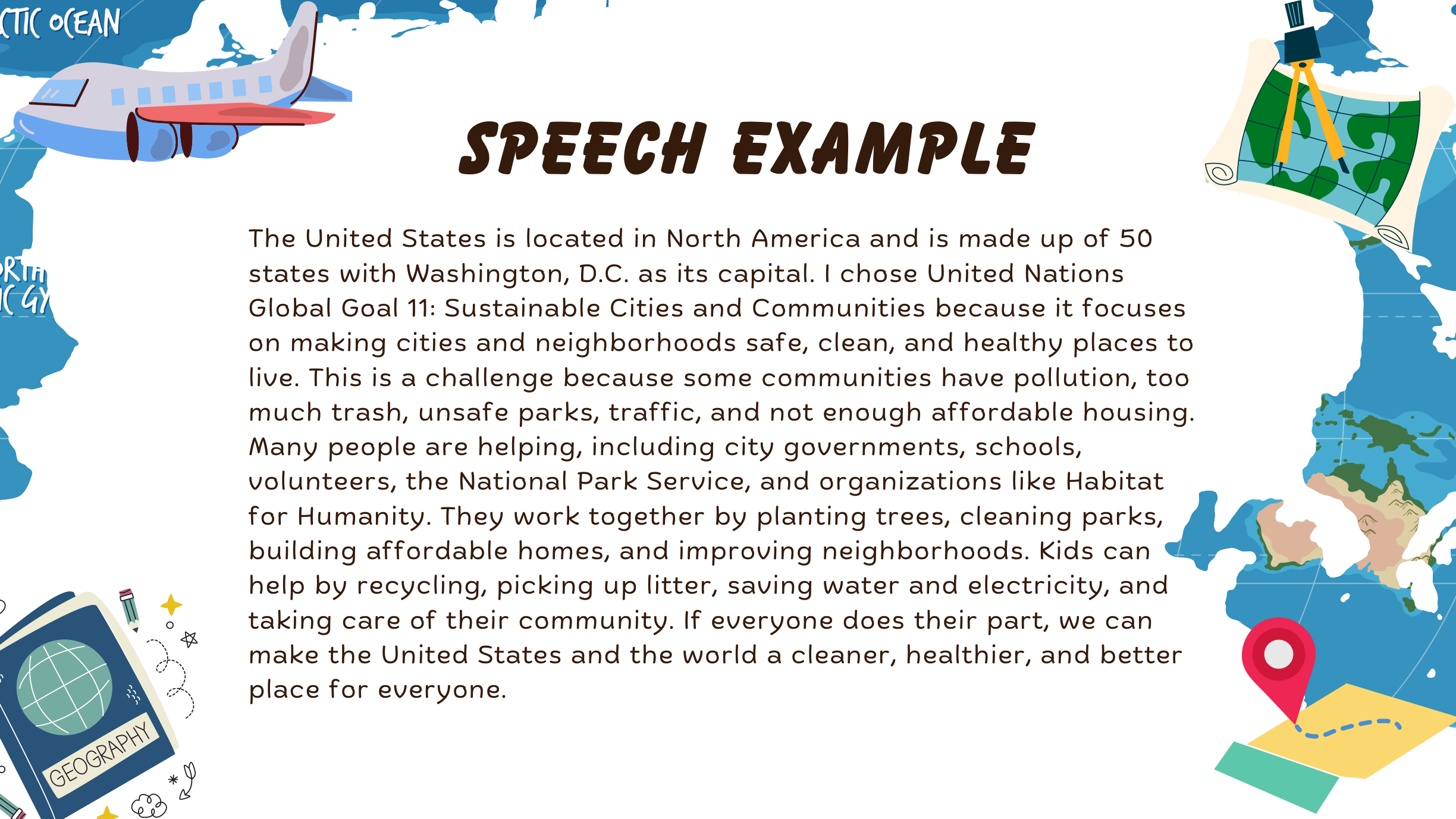
The United States is located in North America and is made up of 50 states with Washington, D.C. as its capital. I chose United Nations Global Goal 11: Sustainable Cities and Communities because it focuses on making cities and neighborhoods safe, clean, and healthy places to live. This is a challenge because some communities have pollution, too much trash, unsafe parks, traffic, and not enough affordable housing. Many people are helping, including city governments, schools, volunteers, the National Park Service, and organizations like Habitat for Humanity. They work together by planting trees, cleaning parks, building affordable homes, and improving neighborhoods. Kids can help by recycling, picking up litter, saving water and electricity, and taking care of their community. If everyone does their part, we can make the United States and the world a cleaner, healthier, and better place for everyone.

World Showcase Project Explanation - Side Show.pdf · page 11

Open original image at full sizeOriginal slide page 11; readable text is provided above
Original source image · page 11
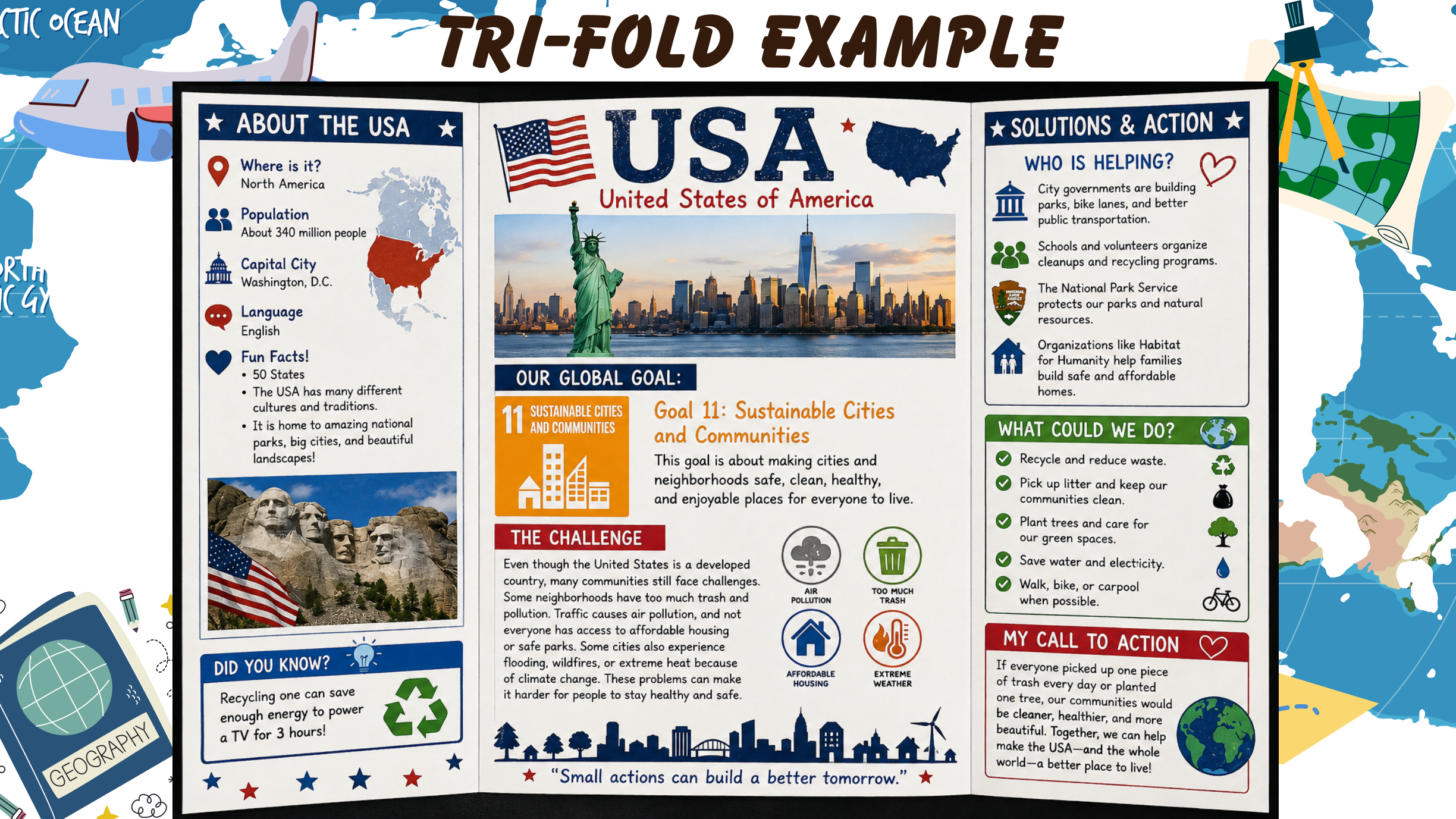
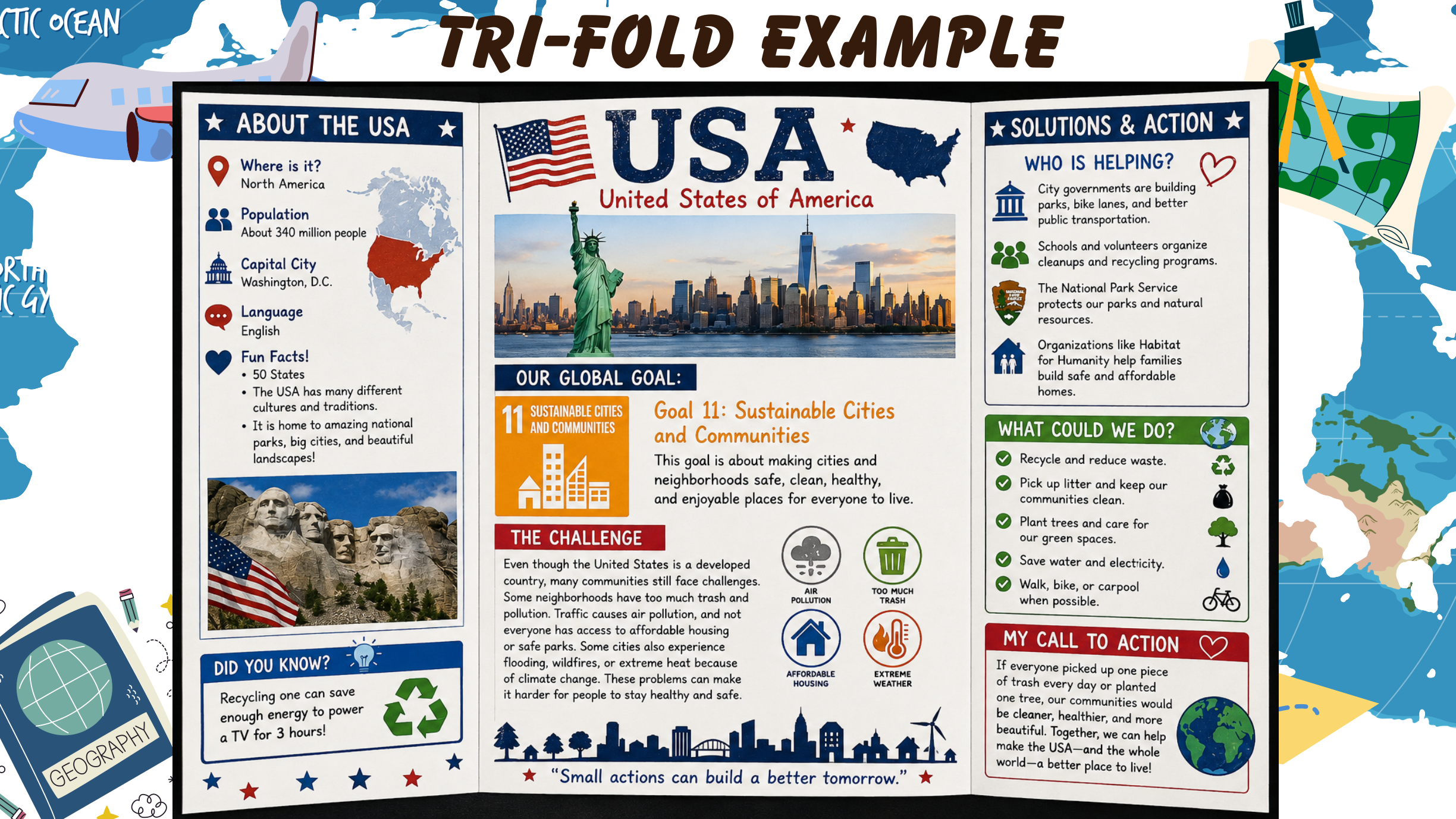
Slide 12 of 13 · Tri-fold example

About the USA

  • Where is it? North America
  • Population: About 340 million people
  • Capital City: Washington, D.C.
  • Language: English

Fun Facts!

  • 50 States
  • The USA has many different cultures and traditions.
  • It is home to amazing national parks, big cities, and beautiful landscapes!

Did you know?

Recycling one can save enough energy to power a TV for 3 hours!

USA — United States of America

Our Global Goal: Goal 11: Sustainable Cities and Communities

This goal is about making cities and neighborhoods safe, clean, healthy, and enjoyable places for everyone to live.

The Challenge

Even though the United States is a developed country, many communities still face challenges. Some neighborhoods have too much trash and pollution. Traffic causes air pollution, and not everyone has access to affordable housing or safe parks. Some cities also experience flooding, wildfires, or extreme heat because of climate change. These problems can make it harder for people to stay healthy and safe.

  • Air pollution
  • Too much trash
  • Affordable housing
  • Extreme weather

Solutions & Action — Who is helping?

  • City governments are building parks, bike lanes, and better public transportation.
  • Schools and volunteers organize cleanups and recycling programs.
  • The National Park Service protects our parks and natural resources.
  • Organizations like Habitat for Humanity help families build safe and affordable homes.

What could we do?

  • Recycle and reduce waste.
  • Pick up litter and keep our communities clean.
  • Plant trees and care for our green spaces.
  • Save water and electricity.
  • Walk, bike, or carpool when possible.

My Call to Action

If everyone picked up one piece of trash every day or planted one tree, our communities would be cleaner, healthier, and more beautiful. Together, we can help make the USA—and the whole world—a better place to live!

“Small actions can build a better tomorrow.”

World Showcase Project Explanation - Side Show.pdf · page 12

Open original image at full sizeOriginal slide page 12; readable text is provided above
Original source image · page 12
Slide 13 of 13 · Video Time!

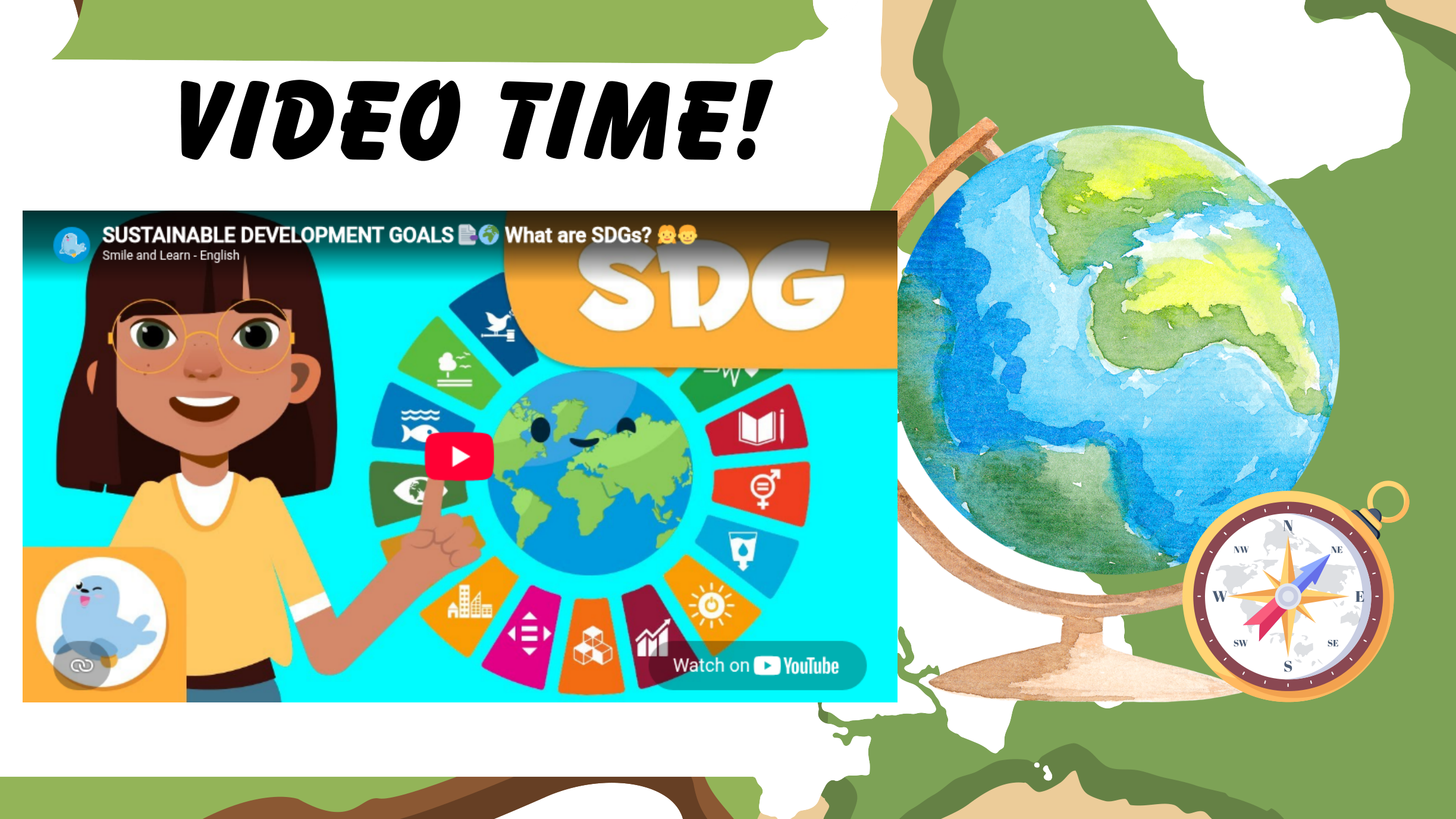
The slide shows a Smile and Learn SDG overview video preview. The PDF is a still image, not a playable video.

Watch the overview and goal videos in the SDG panel

World Showcase Project Explanation - Side Show.pdf · page 13

Open original image at full sizeOriginal slide page 13; readable text is provided above
Original source image · page 13
Full Canvas project directions — all 4 pages

Teacher directions with layout and spacing normalized. LMS print headers, footers, timestamps, and course metadata are omitted. Two Headquarters buttons are clipped in the source PDF; no missing words or URLs are guessed.

Canvas directions · page 1

The World Showcase Project

Explore a country. Investigate a challenge. Create a solution.

Every country has strengths. Every country has challenges. Every person can make a difference.

Essential Question

How can we learn about a country by learning how people are making the world a better place?

World Showcase Headquarters

Use these buttons to find everything you need for the project.

The World Showcase - PDF of Canvas Explanation.pdf · page 1

Canvas directions · page 2

Your Mission

You will become an expert on one country. You will research what makes your country special, investigate a challenge connected to one of the United Nations Global Goals, and develop ideas for making a difference.

You will share your learning through a creative tri-fold display and a seven-sentence speech.

Your Project Road Map

Step 1: Pick a Country

Each historian will research a different country. Keep an open mind and choose a country you are excited to explore.

Remember: The United States is not an available choice.

Step 2: Learn About Your Country

  • Location
  • Capital
  • Population
  • Languages
  • Food
  • Traditions and culture
  • Flag
  • Interesting facts

Step 3: Pick a Challenge

Choose one United Nations Global Goal that connects to a challenge faced by people in your country.

Step 4: Become a Problem Solver

  1. What is happening?
  2. Why is it happening?
  3. Who is affected by this challenge?
  4. Who is already helping?
  5. How can kids and communities help?

The World Showcase - PDF of Canvas Explanation.pdf · page 2

Canvas directions · page 3

Step 5: Build Your Tri-Fold

Organize your research, add colorful visuals, and make your information easy for World Showcase visitors to understand.

Tri-Fold Display Guide

Left Panel — About My Country

  • Map
  • Flag
  • Capital
  • Population
  • Culture
  • Food
  • Interesting facts

Center Panel — Country and Challenge

  • Large country title
  • Large picture
  • Chosen Global Goal
  • Explanation of the challenge
  • Why the challenge matters

Right Panel — Solutions

  • Organizations helping
  • What kids can do
  • Your big idea
  • Call to action

Be an Advocate: Your Seven-Sentence Speech

  1. Introduce your country and tell where it is located.
  2. Explain which United Nations Global Goal you chose.
  3. Describe why this is a challenge in your country.
  4. Explain how the challenge affects people.
  5. Tell who is helping solve the problem.
  6. Describe what kids or communities can do to help.
  7. End with your solution or a call to action that inspires others.

Type it • Print it • Memorize it

Before You Say, “I’m Finished!”

Make sure you can answer yes to each question:

  • Did I include all required country information?
  • Did I clearly identify my Global Goal?

The World Showcase - PDF of Canvas Explanation.pdf · page 3

Canvas directions · page 4

  • Did I explain the challenge and why it matters?
  • Did I include organizations and people who are helping?
  • Did I explain how kids can help?
  • Did I include my own big idea or call to action?
  • Is my tri-fold neat, colorful, creative, and easy to read?
  • Did I type, print, and practice my seven-sentence speech?
  • Did I check the rubric?

Historians, Do You Need Help?

Review the project directions, check your research resources, ask a classmate, and then ask Mrs. Carson. Strong researchers ask questions!

Think Globally • Act Locally • Make a Difference

Fifth Grade World Showcase

The World Showcase - PDF of Canvas Explanation.pdf · page 4
El Salvador is the official country

The project is due Thursday, September 10. Use the Timeline to finish the idea, speech draft, and first trifold build today.

Five steps. One thing at a time.

This order combines the Canvas page, slide deck, and grading rubric.

  1. 1
    Teacher Required

    Official country

    Ella’s confirmed country is El Salvador.

  2. 2
    Teacher Required

    Learn about the country

    Location, map, flag, capital, population, languages, food, traditions/culture, and interesting facts.

  3. 3
    Ella Chooses

    Pick one challenge and Global Goal

    The challenge must affect people in El Salvador and connect clearly to one UN Sustainable Development Goal.

  4. 4
    Teacher Required

    Become a problem solver

    What is happening? Why? Who is affected? Who is already helping? How can kids and communities help?

  5. 5
    Teacher Required

    Build, write, practice

    Make the trifold neat, colorful, original, and easy to follow. Type and print the seven-sentence paragraph, then memorize and practice it.

Verified facts and three challenge paths

These are source-backed starting points—not Ella’s finished work. She chooses one path, opens the sources, takes notes, and rewrites the ideas in her own words.

Official nameRepublic of El Salvador
LocationCentral America; bordered by Guatemala, Honduras, and the Pacific Ocean
CapitalSan Salvador
Population6,365,503 people in 2025
Size21,041 km² (8,123 mi²)—the smallest country in Central America
LanguagesNational Geographic Kids lists Spanish and Nahua
MoneyU.S. dollar
Land & cultureKnown as the Land of Volcanoes; soccer is popular; rice, beans, and tortillas are common foods

Accuracy note: National Geographic Kids has an older population figure. The site uses the World Bank’s 2025 value. Ella should record the year with the number.

Ella’s Choice

Option B · SDG 6

Reliable water services

Droughts, storms, and floods can interrupt water service. Communities need systems that are reliable, efficient, and prepared for climate hazards.

Possible action: a home/class water-use audit or non-drinking rainwater-capture model.

Open the World Bank source
Ella’s Choice

Option C · SDG 4

Safe, supportive schools

Schools work to reduce learning gaps and prepare for earthquakes, floods, landslides, storms, volcanic eruptions, and droughts.

Possible action: create a disaster-ready classroom checklist or demonstrate cross-bracing with a model building.

Open the UNICEF source

Tell the story with dignity

Describe El Salvador’s strengths, people, landscapes, and solutions—not only a problem. Say “some families have difficulty accessing nutritious food,” not “the people are starving.” Mention progress and the people already solving problems.

Teacher’s complete research resources document

World Showcase Resources

National Geographic Kids

https://kids.nationalgeographic.com/geography/countries/article/el-salvador\

Open El Salvador country article

Understanding the SDG’s

https://www.youtube.com/playlist?list=PLK03QG-t1CNxn3KA6DvMGT42uv1YXINsj

Reference

National Geographic Kids

https://kids.nationalgeographic.com/

Kids World Travel Guide

https://www.kids-world-travel-guide.com/

Globe Trottin’ Kids

https://www.globetrottinkids.com/explore/

Britannica Kids

https://kids.britannica.com/

Specific Use Above for El Salvador

View verbatim research document text
World Showcase Resources * National Geographic Kids * https://kids.nationalgeographic.com/geography/countries/article/el-salvador\ * Understanding the SDG’s * https://www.youtube.com/playlist?list=PLK03QG-t1CNxn3KA6DvMGT42uv1YXINsj * Reference * National Geographic Kids (https://kids.nationalgeographic.com/) * Kids World Travel Guide (https://www.kids-world-travel-guide.com/) * Globe Trottin’ Kids (https://www.globetrottinkids.com/explore/) * Britannica Kids (https://kids.britannica.com/) Specific Use Above for El Salvador * * *

World Showcase - Research Resources · complete document

See the board before building it

The left panel explains the country. The center makes the big connection. The right shows solutions and action.

About the USA

Where is it?

North America

Population

About 340 million people

Capital City

Washington, D.C.

Language

English

Fun Facts
  • 50 states
  • Many different cultures and traditions
  • National parks, big cities, and landscapes
LANDMARK PHOTO
Mount Rushmore in teacher example
Did You Know?

Recycling one can saves enough energy to power a TV for 3 hours.

FLAG

USA

MAP

United States of America

COUNTRY HERO PHOTO
New York skyline in teacher example

Our Global Goal

11
Sustainable Cities & Communities

Make cities and neighborhoods safe, clean, healthy, and enjoyable.

The Challenge

Pollution, trash, affordable housing, safe parks, wildfires, and extreme heat can make healthy living harder.

Air pollutionToo much trashAffordable housingExtreme weather

Solutions & Action

Who is helping?

  • City governments
  • Schools and volunteers
  • National Park Service
  • Habitat for Humanity

What could we do?

  • Recycle and reduce waste
  • Pick up litter
  • Plant trees
  • Save water and electricity
  • Walk, bike, or carpool
My Call to Action

Small actions can build a better tomorrow.

About El Salvador

Where is it?

Central America, bordered by Guatemala, Honduras, and the Pacific Ocean.

Ella rewrites this in her own words.
Map + Flag

Add clear, labeled visuals.

Capital + Population

San Salvador · 6,365,503 people in 2025.

Languages

Research starting point: Spanish and Nahua.

Food + Culture

Possible choices: soccer; rice, beans, tortillas; research pupusas.

Interesting Facts

Smallest Central American country; mountainous “Land of Volcanoes.”

ADD A LANDMARK OR LANDSCAPE PHOTO
FLAG

EL SALVADOR

MAP
ADD ONE LARGE COUNTRY PHOTO

Our Global Goal

Example path: Goal 2 · Zero Hunger

Ella may choose this or one of the other researched options.

The Challenge

When weather changes, food systems must adapt

Droughts and storms can damage crops and income. Food prices and low incomes can make healthy food harder for some families to access.

Dry CorridorCrop damageFood accessClimate-smart farming

Ella’s job: choose the evidence, rewrite it, and explain why she cares.

Solutions & Action

Who is helping?

Example: World Food Programme, government partners, farmers, schools, and communities.

What they do

School meals, community gardens, drip irrigation, rainwater harvesting, pumps, and farmer support.

What kids can do

Choose one: food-waste audit, careful watering, a small garden, or awareness pledge.

My Big Idea

Ella chooses or invents an achievable idea.

Possible Call to Action

“Grow food, save water, waste less.” Ella should rewrite it.

What belongs on each panel?

Teacher’s slide 9 · Building Your Trifold

Left Panel

  • About My Country
  • Map
  • Flag
  • Capital
  • Population
  • Culture
  • Food
  • Interesting Facts

Middle Panel

  • Large title
  • Country Name
  • Big picture
  • Chosen Global Goal
  • Explain the challenge
  • Explain why it matters

Right Panel

  • Solutions
  • Organizations helping
  • What kids can do
  • My Big Idea
  • Call to Action
Teacher-provided slide 12 showing a completed United States trifold example

Teacher-provided Slide 12. Use it as inspiration—not as content to copy.

What belongs on each panel?

Teacher’s slide 9 · Building Your Trifold

Left Panel

  • About My Country
  • Map
  • Flag
  • Capital
  • Population
  • Culture
  • Food
  • Interesting Facts

Middle Panel

  • Large title
  • Country Name
  • Big picture
  • Chosen Global Goal
  • Explain the challenge
  • Explain why it matters

Right Panel

  • Solutions
  • Organizations helping
  • What kids can do
  • My Big Idea
  • Call to Action
Teacher slide 9 showing the required components for the left, center and right trifold panels

Why this layout earns rubric points

Left covers Country Basics and Culture & Facts. Center covers the Global Goal and Country Challenge. Right covers Helpers, Solutions, Student Action, Big Idea, and Call to Action.

Teacher’s exact trifold panel guide

LEFT PANEL

  • About My Country
  • Map
  • Flag
  • Capital
  • Population
  • Culture
  • Food
  • Interesting Facts

CENTER PANEL

  • Large title
  • Country Name
  • Big picture
  • Chosen Global Goal
  • Explain the challenge
  • Explain why it matters

RIGHT PANEL

  • Solutions
  • Organizations helping
  • What kids can do
  • My Big Idea
  • Call to Action

World Showcase Project Explanation - Side Show.pdf · page 9

Canvas display guide

Left Panel — About My Country

  • Map
  • Flag
  • Capital
  • Population
  • Culture
  • Food
  • Interesting facts

Center Panel — Country and Challenge

  • Large country title
  • Large picture
  • Chosen Global Goal
  • Explanation of the challenge
  • Why the challenge matters

Right Panel — Solutions

  • Organizations helping
  • What kids can do
  • Your big idea
  • Call to action

The World Showcase - PDF of Canvas Explanation.pdf · page 3

Open original image at full sizeOriginal slide page 12; readable text is provided above
Original source image · page 12

My three-day plan

One day at a time. Due Thursday, September 10.

Monday, September 7

Choose and start

Holiday · Full day available

  • Learn about El Salvador and the goals. Choose one goal and challenge.
  • Plan all three trifold panels and begin the layout.
  • Write all seven sentences and do one full speech practice.

Tuesday, September 8

Finish the trifold

No evening obligations

  • Finish the trifold design and assembly.
  • Check the grading rubric and print the speech.
  • Practice the speech several times. Try without notes.

Wednesday, September 9

Practice and pack

Leave at 4:30 PM for cheer practice

  • Practice speaking clearly and confidently after school.
  • Do one short practice after cheer.
  • Use Final Check. Pack the finished trifold and printed speech.

Build exactly seven sentences

Type it, print it, memorize it, and practice it. Each sentence has one job.

These seven prompts follow the teacher’s Canvas directions, in the same order.

Ready to save

Automatically saves in this browser on this device. Clearing browser data removes this draft. Use Print for a separate copy.

  1. Introduce El Salvador and tell where it is located.
  2. Explain which United Nations Global Goal you chose.
  3. Describe why this is a challenge in El Salvador.
  4. Explain how the challenge affects people.
  5. Tell who is helping solve the problem.
  6. Describe what kids or communities can do.
  7. End with Ella’s solution or an inspiring call to action.

Your speech saves automatically in this browser. Use Save Speech to save now, or Print for a separate copy.

Teacher’s original speech directions and example

Canvas seven-sentence directions

  1. Introduce your country and tell where it is located.
  2. Explain which United Nations Global Goal you chose.
  3. Describe why this is a challenge in your country.
  4. Explain how the challenge affects people.
  5. Tell who is helping solve the problem.
  6. Describe what kids or communities can do to help.
  7. End with your solution or a call to action that inspires others.

Type it • Print it • Memorize it

The World Showcase - PDF of Canvas Explanation.pdf · page 3

Introduction slide directions

  1. Introduce your country and where it is located.
  2. Explain which United Nations Global Goal you chose.
  3. Describe why this is a challenge in your country.
  4. Explain how this challenge affects people.
  5. Tell who is helping solve the problem.
  6. Describe what kids or communities can do to help.
  7. End with your own solution or a call to action to inspire others.

*You will memorize this & You will type and print this out to turn in.

World Showcase Project Explanation - Side Show.pdf · page 10

Teacher’s USA example — not a speech to copy

The United States is located in North America and is made up of 50 states with Washington, D.C. as its capital. I chose United Nations Global Goal 11: Sustainable Cities and Communities because it focuses on making cities and neighborhoods safe, clean, and healthy places to live. This is a challenge because some communities have pollution, too much trash, unsafe parks, traffic, and not enough affordable housing. Many people are helping, including city governments, schools, volunteers, the National Park Service, and organizations like Habitat for Humanity. They work together by planting trees, cleaning parks, building affordable homes, and improving neighborhoods. Kids can help by recycling, picking up litter, saving water and electricity, and taking care of their community. If everyone does their part, we can make the United States and the world a cleaner, healthier, and better place for everyone.

World Showcase Project Explanation - Side Show.pdf · page 11

17 goals for a better world

Learn what the goals mean. Then watch the overview and explore the videos below.

All 17 Sustainable Development Goals in English

1. No Poverty: Help everyone meet basic needs.

2. Zero Hunger: Help everyone have enough nutritious food.

3. Good Health and Well-Being: Help people stay healthy and get care.

4. Quality Education: Help every child learn.

5. Gender Equality: Give girls and boys equal rights and opportunities.

6. Clean Water and Sanitation: Provide safe water and clean toilets.

7. Affordable and Clean Energy: Make clean energy available to everyone.

8. Decent Work and Economic Growth: Help people find safe, fair jobs.

9. Industry, Innovation and Infrastructure: Build useful roads, services, and new ideas.

10. Reduced Inequalities: Give everyone a fair chance.

11. Sustainable Cities and Communities: Make communities safe and good places to live.

12. Responsible Consumption and Production: Use resources wisely and waste less.

13. Climate Action: Help protect people and the planet from climate change.

14. Life Below Water: Protect oceans and ocean life.

15. Life on Land: Protect forests, wildlife, and nature.

16. Peace, Justice and Strong Institutions: Help people live safely and be treated fairly.

17. Partnerships for the Goals: Work together to reach all the goals.

Watch here — start with the overview

Read the complete SDG action guide — 4 levels

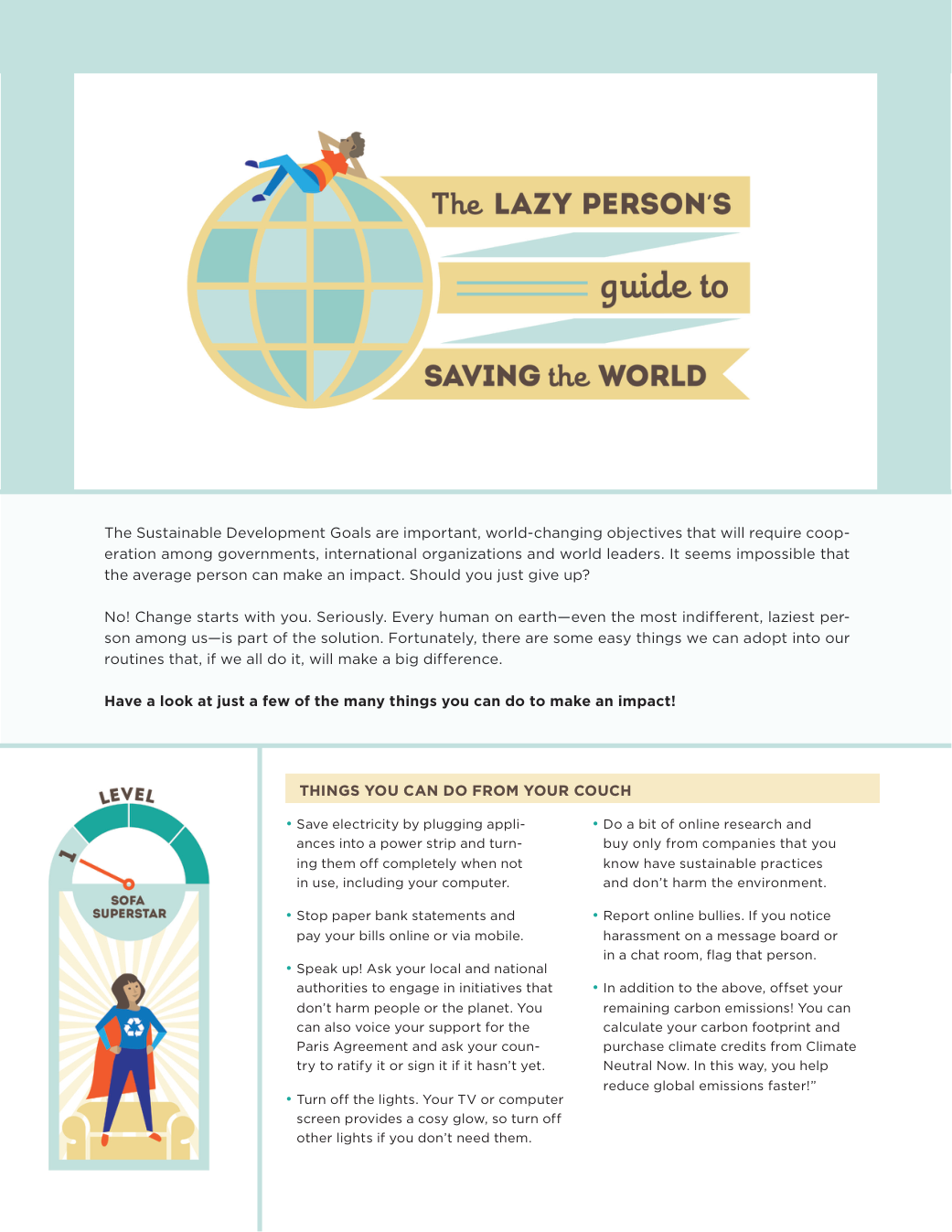
The Lazy Person’s Guide to Saving the World

The Sustainable Development Goals are important, world-changing objectives that will require cooperation among governments, international organizations and world leaders. It seems impossible that the average person can make an impact. Should you just give up? No! Change starts with you. Seriously. Every human on earth—even the most indifferent, laziest person among us—is part of the solution. Fortunately, there are some easy things we can adopt into our routines that, if we all do it, will make a big difference. Have a look at just a few of the many things you can do to make an impact!

Level 1 · Sofa Superstar — Things you can do from your couch
  • Save electricity by plugging appliances into a power strip and turning them off completely when not in use, including your computer.
  • Stop paper bank statements and pay your bills online or via mobile.
  • Speak up! Ask your local and national authorities to engage in initiatives that don’t harm people or the planet. You can also voice your support for the Paris Agreement and ask your country to ratify it or sign it if it hasn’t yet.
  • Turn off the lights. Your TV or computer screen provides a cosy glow, so turn off other lights if you don’t need them.
  • Do a bit of online research and buy only from companies that you know have sustainable practices and don’t harm the environment.
  • Report online bullies. If you notice harassment on a message board or in a chat room, flag that person.
  • In addition to the above, offset your remaining carbon emissions! You can calculate your carbon footprint and purchase climate credits from Climate Neutral Now. In this way, you help reduce global emissions faster!”

World Showcase - Lazy Person's Guide to United Nations SDGs.pdf · page 1

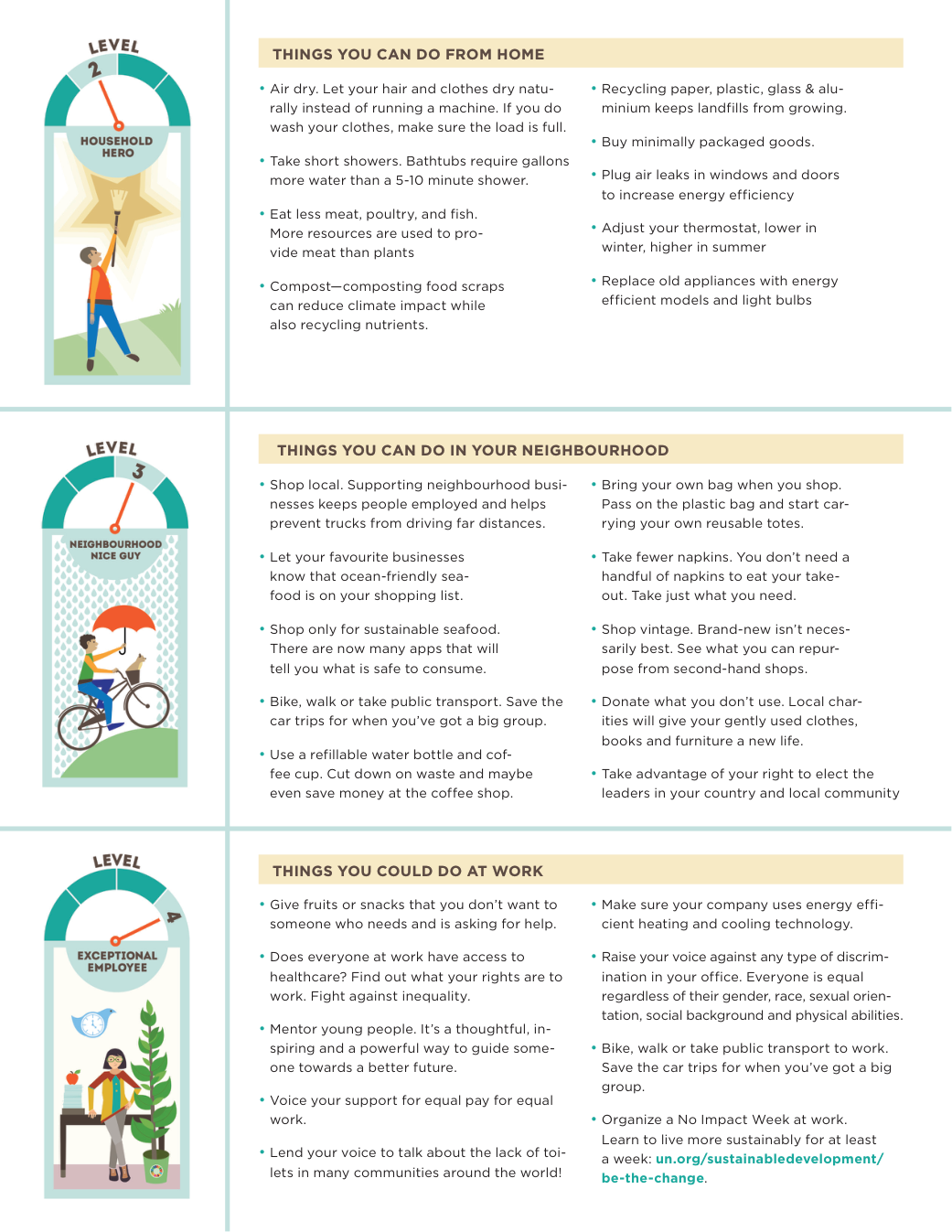
Level 2 · Household Hero — Things you can do from home
  • Air dry. Let your hair and clothes dry naturally instead of running a machine. If you do wash your clothes, make sure the load is full.
  • Take short showers. Bathtubs require gallons more water than a 5-10 minute shower.
  • Eat less meat, poultry, and fish. More resources are used to provide meat than plants
  • Compost—composting food scraps can reduce climate impact while also recycling nutrients.
  • Recycling paper, plastic, glass & aluminium keeps landfills from growing.
  • Buy minimally packaged goods.
  • Plug air leaks in windows and doors to increase energy efficiency
  • Adjust your thermostat, lower in winter, higher in summer
  • Replace old appliances with energy efficient models and light bulbs

World Showcase - Lazy Person's Guide to United Nations SDGs.pdf · page 2

Level 3 · Neighbourhood Nice Guy — Things you can do in your neighbourhood
  • Shop local. Supporting neighbourhood businesses keeps people employed and helps prevent trucks from driving far distances.
  • Let your favourite businesses know that ocean-friendly seafood is on your shopping list.
  • Shop only for sustainable seafood. There are now many apps that will tell you what is safe to consume.
  • Bike, walk or take public transport. Save the car trips for when you’ve got a big group.
  • Use a refillable water bottle and coffee cup. Cut down on waste and maybe even save money at the coffee shop.
  • Bring your own bag when you shop. Pass on the plastic bag and start carrying your own reusable totes.
  • Take fewer napkins. You don’t need a handful of napkins to eat your takeout. Take just what you need.
  • Shop vintage. Brand-new isn’t necessarily best. See what you can repurpose from second-hand shops.
  • Donate what you don’t use. Local charities will give your gently used clothes, books and furniture a new life.
  • Take advantage of your right to elect the leaders in your country and local community

World Showcase - Lazy Person's Guide to United Nations SDGs.pdf · page 2

Level 4 · Exceptional Employee — Things you could do at work
  • Give fruits or snacks that you don’t want to someone who needs and is asking for help.
  • Does everyone at work have access to healthcare? Find out what your rights are to work. Fight against inequality.
  • Mentor young people. It’s a thoughtful, inspiring and a powerful way to guide someone towards a better future.
  • Voice your support for equal pay for equal work.
  • Lend your voice to talk about the lack of toilets in many communities around the world!
  • Make sure your company uses energy efficient heating and cooling technology.
  • Raise your voice against any type of discrimination in your office. Everyone is equal regardless of their gender, race, sexual orientation, social background and physical abilities.
  • Bike, walk or take public transport to work. Save the car trips for when you’ve got a big group.
  • Organize a No Impact Week at work. Learn to live more sustainably for at least a week: un.org/sustainabledevelopment/be-the-change.

World Showcase - Lazy Person's Guide to United Nations SDGs.pdf · page 2

Original guide image · page 1
Original guide image · page 2

Before Ella says “I’m finished”

Use this after the trifold is assembled and the seven sentences are complete.

Before I say “I’m finished,” can I answer yes?

0 of 9 checked in this session
Teacher’s exact final check — “Before You Say, I’m Finished!”

Make sure you can answer yes to each question:

  • Did I include all required country information?
  • Did I clearly identify my Global Goal?
  • Did I explain the challenge and why it matters?
  • Did I include organizations and people who are helping?
  • Did I explain how kids can help?
  • Did I include my own big idea or call to action?
  • Is my tri-fold neat, colorful, creative, and easy to read?
  • Did I type, print, and practice my seven-sentence speech?
  • Did I check the rubric?

The World Showcase - PDF of Canvas Explanation.pdf · page 3

The World Showcase - PDF of Canvas Explanation.pdf · page 4
Project files and research links

These links open the original materials. The website organizes them but does not replace the official directions.

Learn to build it with your voice

Ella makes the decisions. Sterling turns her spoken ideas into a draft she can inspect, question, and improve.

1

Say what you want

“I want my center panel to show…”

2

Explain why

“This matters because…”

3

Ask for options

“Show me three layouts, but don’t choose for me.”

4

Check the source

“Where did that fact come from?”

5

Revise it

“Make this clearer in words I would actually say.”

Good voice prompts to try

Learning rule: Sterling can organize, explain, offer choices, and check requirements. Ella chooses the ideas, writes in her own voice, and gives the presentation.